
How Long Will Your Retirement Money Last?
Suppose that you have saved and invested for your retirement and have $100,000 in your retirement account. You decide to start your retirement by withdrawing $5,000 in the first year. The next year you take out another $5,000. If you keep taking out $5,000 each year, in 20 years ($100,000/$5,000), you would be out of money.
But if you assume you can add money to the account each year with interest, dividends and capital gains, you may extend the withdrawal period to more than 20 years. But what happens if you need to take out more than $5,000, because your expenses increase due to inflation? If you regularly increase the amount of the withdrawal because of inflation, your money may not last the 20 years.
Example - Start with $100,000 and Withdraw $5,000
The following chart of drawdown curves shows how much you will have left in your account after withdrawing money for different number of years. The selected inflation rate is 4 percent and the different annual rates of return that you could receive on the account are 0 percent, 2 percent, 4 percent, 6 percent, 8 percent and 10 percent.
Each year the amount withdrawn increases by 4 percent to keep up with inflation. So eventually the annual withdrawal is large. For example, at a 4 percent annual inflation rate a $5,000 withdrawal in year 1 grows to $10,534 in year 20 and to $15,593 by year 30.
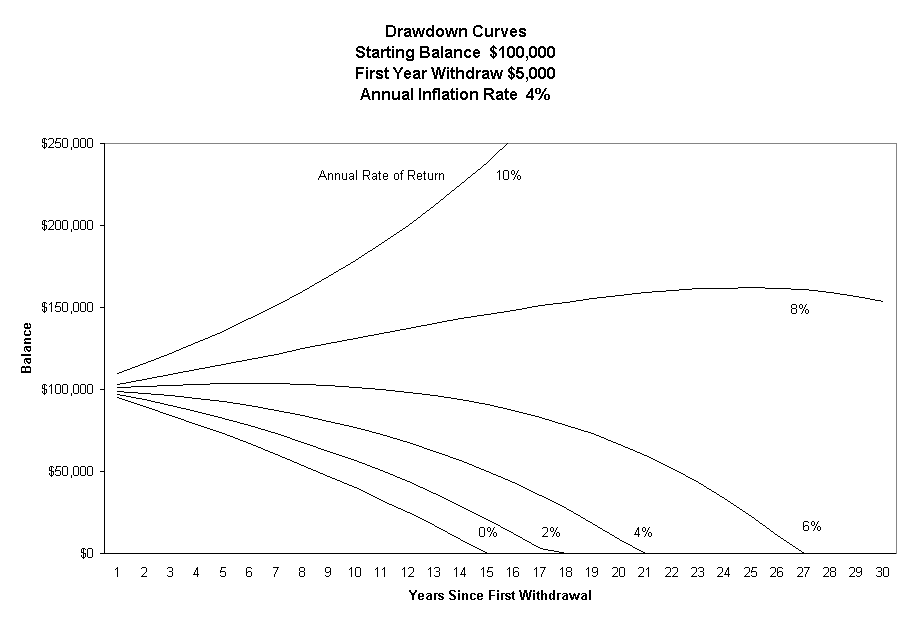
You can see that for 0 percent, 2 percent, 4 percent and 6 percent annual rates of return, you run out of money in 15, 18, 21 and 27 years respectively. At 8 percent your account makes money for a few years and then starts to decline as the inflation-adjusted withdraws increase. But you'll have enough money for years and years.
For a 10 percent annual return you actually accumulate money in the account even after inflation and the withdrawals. Why is this? When the rate of return is high enough, more money is added to the account than is taken out so the account balance increases rather than decreases.
But for higher inflation rates, the inflation-adjusted withdrawals increase so that the account is drained in a few years. For example at 6 percent the $5,000 withdrawal explodes to $15,128 in year 20 and $27,092 in year 30. At 6 percent inflation the account goes to a zero balance in 14 years for 0 percent, 2 percent and 4 percent annual returns. For 6 percent, 8 percent and 10 percent returns the account goes to zero in 15 years. So at higher inflation rates even high returns can't protect you.
Example - Start with $500,000 and Withdraw $5,000 to $25,000
In this example you start with $500,000. Each year you receive a 6 percent return and the withdrawal amount is adjusted for a 4 percent rate of inflation. The first year withdrawal amounts are: $5,000, $10,000, $15,000, $20,000 or $25,000. The following drawdown curves show the annual balance given different amounts withdrawn each year.

For first-year withdrawals of $5,000 and $10,000 money accumulates in the account and you never run out. For the $15,000 withdrawal amount money accumulates and then starts to decline. For the $20,000 and $25,000 withdrawal amounts you run out of money in years 37 and 27 respectively after the first withdrawal.
In real time the annual rates of return and inflation fluctuate. You could have years of high returns followed by years of low returns depending on the type of investments in the account. But if the returns consistently out pace inflation, you have a good chance of not running out of money. Obviously you can't control inflation, but with luck and skill you might out perform it. On the other hand if inflation increases significantly and pushes up your expenses and your returns do not keep pace, you could quickly run out of money.
Withdrawal, Inflation and Purchasing Power Calculators
Use the Nest Egg Withdrawal Calculator to see how long your money will last for different withdrawal rates.
And use the Inflation Calculator and the Purchasing Power Calculator to understand the impact that inflation is likely to have on your finances. Suppose that you needed $60,000 for your first year of retirement. How much money would you need in 20 years to maintain the same purchasing power as today? The calculators will provide the answer.
Conclusions
Managing your retirement account is tricky once you start withdrawing money. You must withdraw enough money to meet your expenses, but you don't want to run out. Unfortunately inflation, which you can't control, can erode the account very rapidly.
You can try to offset the effect of inflation by carefully investing to seek high returns from volatile stocks and risky bonds. But that strategy may prove risky and you can loose money. But if you're too conservative, you won't have high enough returns to replenish the account.
Related Calculators
Investment Goal Calculator - Future Value